
Most people who decide to take their own protection seriously go about it in the wrong order. The gun comes first. The holster comes later, and it is usually the wrong one. Training, if it happens at all, happens last.
That order makes complete sense emotionally. It makes very little sense practically.
Twenty nine states now let a legally eligible adult carry concealed with no permit at all. That is a majority of the country by state count and close to half of it by population, and the number has been stable since 2024. If you live in one of them, nobody is going to make you sit in a classroom before you start carrying.
Which raises a fair question. If the state is not asking, why bother?
What The Permit Gets You, Even Where It Is Optional
Three things, and they are all practical rather than philosophical.
It travels
Permitless carry stops at the state line. It is a rule about what that one state will tolerate, not a national right of passage. Cross into the next state and you are subject to whatever that legislature decided, and a surprising number of them will treat you as a felon for something that was perfectly legal twenty minutes earlier.
A permit from a state with broad reciprocity covers you across a large share of the country. Without one, your plan for a road trip is either to disarm at every border or to hope nobody asks. Neither is much of a plan.
It can get you out of the background check at the counter
This one is less well known and genuinely useful. Federal law allows a state carry permit to stand in for the NICS check when you buy from a dealer, provided the permit meets a specific set of conditions and was issued within the last five years. ATF maintains the official list of which permits qualify on its Brady Permit Chart, and that list has been getting longer. Michigan and Alabama permits were added in 2026.
Where it applies, you hand the dealer your permit and you are done. No check, no delay, no sitting in the parking lot waiting for a phone call. Check the chart for your own state rather than assuming, because qualifying and non qualifying permits sit side by side on it and some states appear in both columns depending on the permit type.
It opens doors that stay shut otherwise
Several states dropped the requirement to hold a permit but kept advantages attached to having one. Depending on where you live that can mean fewer off limits locations, an exemption from a waiting period, or a simpler time at a traffic stop. The specifics vary enormously and they change, so this is one to verify locally rather than take on faith.
The Hours Vary Wildly, And That Tells You Something
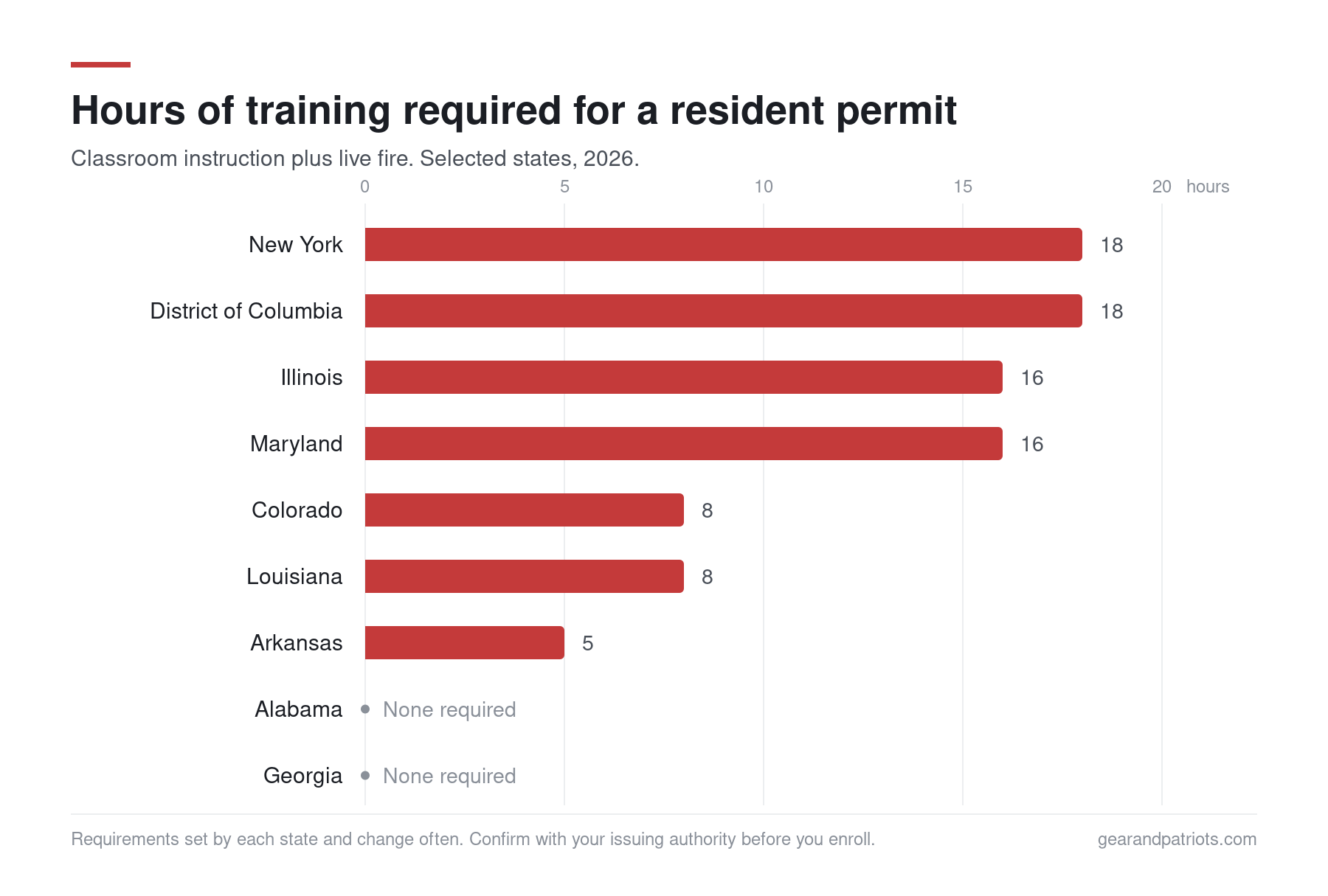
New York and the District of Columbia want eighteen hours. Illinois and Maryland want sixteen. Colorado and Louisiana ask for eight. Arkansas starts at five. Alabama and Georgia require nothing at all.
There is no version of this where sixteen hours is objectively correct and five is objectively wrong. These numbers are political artifacts, not findings. What that means for you is simple and a little uncomfortable: your state’s requirement is not a measure of what it takes to be competent. It is a measure of what passed the legislature.
Treat the requirement as a floor. If you live somewhere that asks for nothing, the honest move is to go find the training anyway.
The Most Valuable Hours Are Not On The Range
This surprises almost everybody. In a good permit class, the hours that pay for themselves are the ones where an instructor walks through what your state actually says about the use of force.
Most people’s understanding of self defense law comes from television, and television is wrong about nearly all of it. The questions that decide whether you go home or go to prison are specific and unglamorous. What counts as a reasonable belief of imminent harm. Whether your state imposes a duty to retreat. What the law permits in defense of property as opposed to defense of a person. Where your protection ends at your own threshold.
Brandishing is the one that catches people out. In a lot of places, pulling a firearm to end an argument is itself a serious crime if the circumstances did not justify deadly force. Plenty of people who have never taken a class do not realize that drawing is a use of force in the eyes of the law, and that the decision to show the gun is legally almost the same decision as the one to fire it.
You cannot reason your way to this. It is specific to your state, it is written down, and a competent instructor will hand it to you in an afternoon.
What The Range Portion Does And Does Not Prove
Where live fire is required, qualifying usually means putting a modest number of rounds into a generous target at close distance with no time pressure and no stress. Passing it demonstrates that you can load, fire and clear the firearm without hurting anyone. That is worth having. It is not the same as being able to shoot well when your hands are shaking.
The bigger gap is what almost no permit class covers in any depth: drawing from concealment. It is the skill you would actually need, it is the one most likely to go badly wrong, and most public ranges will not let you practice it on their line. If you only take one thing from this article, let it be that the permit card does not cover this and you will have to go find it yourself. Our ten day course covers the dry practice side, which is where this work mostly happens anyway.
Where The Permit Stops Helping
- It is not legal advice and it is not a defense. Holding a permit does not make a shooting lawful and it will not keep you out of court. It means you passed a class.
- It expires, and the law moves faster than your renewal. Reciprocity agreements change, states pass new restrictions, and the class you took four years ago described a legal landscape that may no longer exist.
- It does not make you competent. A card in your wallet and a skill in your hands are different things, and the gap between them closes only with practice you schedule yourself.
- It covers one person. Everyone else in your household is on their own plan, and some of them will never carry. That is worth thinking about separately rather than assuming your permit covers the family.
A Reasonable Order To Do This In
- Find out what your state actually requires. Your issuing authority is usually the sheriff or the state police. Their website is the source, not a forum post.
- Take the class even if you are exempt. Pick one that spends real time on the legal block rather than rushing to the range.
- Check the ATF Brady Permit Chart to see whether your permit will save you the background check at purchase.
- Look up reciprocity before you travel, every time, because it changes.
- Keep working on the parts the class skipped. Draw practice, holster selection, and the boring maintenance that keeps the thing running.
A permit is not the finish line and it was never meant to be. What it buys you is a legal footing, a bit of freedom of movement, and a few hours with someone who can tell you what the law in your state actually says. For most people that is the single highest return afternoon available, and in more than half the country nobody is going to make you take it.
Worth pairing with the rest of the picture. Our write up on layered home security covers the part of this that has nothing to do with carrying at all.
This article is general information and not legal advice. Firearm and self defense law is set by each state and changes frequently, and the training figures above reflect published requirements at the time of writing for the states named. Verify current requirements with your state’s issuing authority, confirm reciprocity before you travel, and speak with an attorney licensed in your state about anything touching the use of force.
Leave a Reply